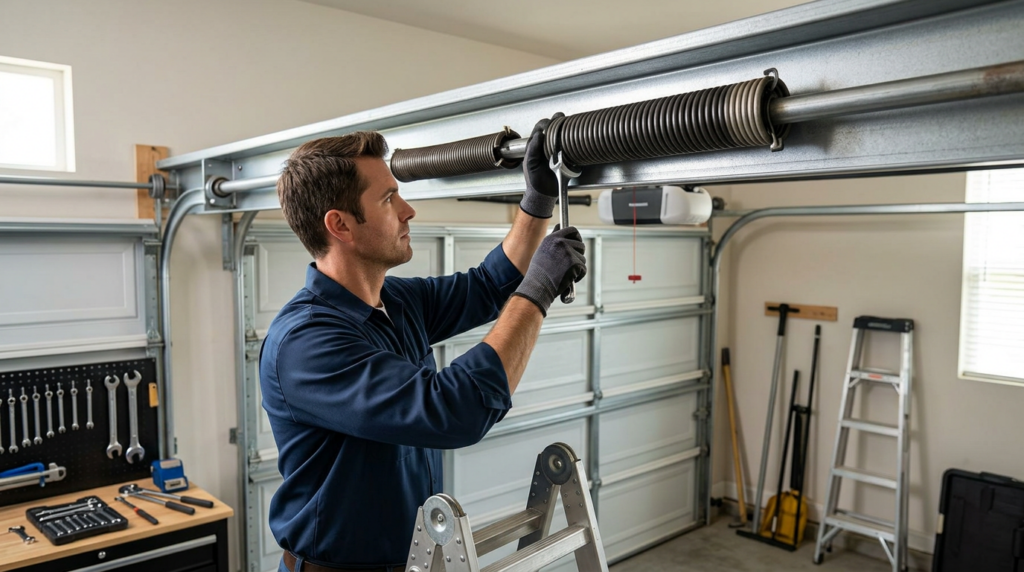
Quick answer: You likely need torsion spring replacement if your garage door suddenly feels extremely heavy, won’t lift more than a few inches, slams shut, or you heard a sharp “bang” from the garage. A broken torsion spring often shows a visible separation in the coil above the door. Because springs are under high tension, replacement is a job for a trained technician, not a DIY fix.
Clear Signs the Torsion Spring Is the Problem
A torsion spring sits on a metal shaft above the garage door and provides most of the lifting force. If it breaks, the opener may strain, the door may only rise a little, or it may not move at all. Many people first notice a loud snap or bang, then find the door suddenly too heavy to lift by hand.
A common visual clue is a visible gap in the spring coil—often a separation of a few inches—on the shaft above the door. You might also see a loose cable hanging near the track, or the door may look slightly crooked because one side is no longer supported evenly. If you’re searching for torsion spring replacement, stop using the door until it’s inspected—forcing it can bend panels, damage the opener, or cause the door to drop unexpectedly.
Decision flow: stop using the door immediately if it’s stuck partially open, hanging crooked, or you see a slack cable, because it can fall without warning. If the door is fully closed, you can do one safe check by pulling the emergency release and lifting the door by hand. Call a pro if the door feels like dead weight, won’t stay about halfway up, or you see that coil gap above the door.
Rule-Outs and Similar Symptoms
Several other issues can mimic a broken torsion spring. These quick checks are generally safe for a homeowner as long as the door is fully closed and you don’t loosen any hardware.
- Dead opener or power issue: Check the outlet/GFCI, opener lights, and whether the wall button works. If the opener is completely dead but the door lifts normally by hand, the spring may be fine.
- Engaged manual lock: Some doors have a center handle lock. If it’s engaged, the opener may hum or stop. Confirm the lock bars aren’t slid into the tracks.
- Off-track or jammed rollers: Look for rollers out of the track, bent track, or a door section wedged. Don’t force it—an off-track door can bind and drop.
- Broken or slipped lift cable: If one side cable is visibly loose or off the drum, the door may rise crooked. Don’t run the opener; this needs service.
- Opener limit/force problem: If the door moves a bit then reverses, the opener may be sensing resistance. If the door feels heavy by hand, suspect spring trouble; if it feels normal, suspect opener adjustment or a binding door.
Why You Shouldn’t Replace a Torsion Spring Yourself
Torsion springs store a lot of energy. Releasing or winding that tension requires the right tools, the correct technique, and a clear understanding of how the spring, drums, cables, and set screws work together. Improvised tools like screwdrivers or rebar can slip, and the shaft can spin unexpectedly.
Beyond personal injury risk, an incorrect spring size or wrong number of turns can create new problems: the door may shoot up, slam down, come off the tracks, or burn out the opener. A technician typically matches the spring to the door’s weight and hardware, then balances the door so the opener isn’t doing the heavy lifting.
What to Expect During a Spring Replacement Visit
A standard service visit usually starts with confirming the failure and checking parts that may have been stressed when the spring broke. That often includes cables, bottom brackets, center bearing plate, end bearings, rollers, drums, and the opener’s force/limit settings. If a cable has frayed or jumped a drum, that’s handled so the door lifts evenly.
After the new spring is installed and wound, the door is tested by hand for balance, then cycled with the opener. Ask the technician what spring size is being installed, whether your setup uses one or two springs, and what replacement options exist (for example, replacing one spring versus both on a two-spring system). For safe diagnosis and repair, contact AA Garage Door LLC.