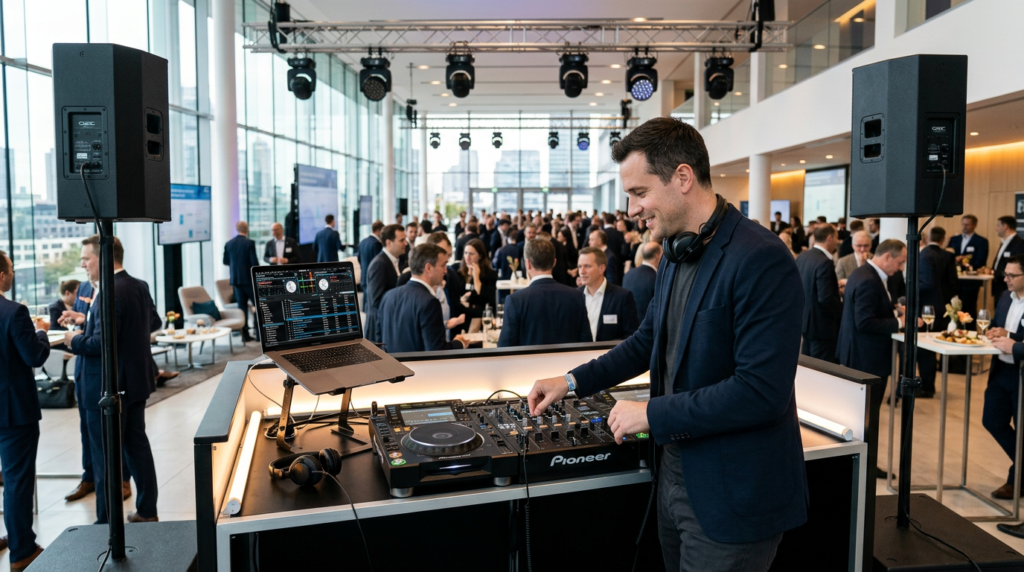
Quick answer: Choose a corporate event DJ by matching their style to your event goal (networking, awards, party), confirming they can handle your venue’s sound limits and setup logistics, and agreeing on a clear music and request policy. Ask for a written run-of-show, typical setup timing (often 1–3 hours depending on gear and access), microphone needs, and a straightforward backup plan for playback and key cables.
Start With the Room and the Run-Of-Show
A good corporate DJ choice starts with your agenda, not your playlist. A drinks reception needs low-volume background music and clean microphone handling; an awards night needs tight cueing for walk-up music and stings; a late-night party needs confident mixing and reading the room. Tell the DJ what “success” looks like: more mingling, a packed dancefloor, or fast transitions between speeches.
Ask how they structure a typical timeline and what they need from you (speaker list, walk-up tracks, brand “do-not-play” list). A professional corporate event dj should be comfortable coordinating with your venue and AV team so music levels, mic handoffs, and announcements don’t feel chaotic.
Also check practical fit: access times, lift or stairs, parking/loading rules, and where the DJ booth can go without blocking sightlines. “Early setup” commonly means arriving about 1–3 hours before guest arrival, with the longer end typical if there’s uplighting, tricky access, or shared AV.
A Copy-Paste DJ Vetting Checklist
Logistics/venue
1) What time do you arrive for setup, and how many hours do you typically need for this venue type?
2) What space do you need for the booth, and can you work with a tight corner or stage wing?
3) What do you require for power (number of sockets, extension leads), and do you bring your own?
4) Can you comply with venue sound limiters or strict volume rules, and how do you manage that in practice?
Audio/mics
5) How many wireless mics can you provide, and what’s your plan for battery swaps during speeches? (A typical threshold: 2+ wireless mics if you have panels/Q&A, roaming presenters, or more than one speaker needing quick handoffs.)
6) Can you provide a separate audio feed for video recording/streaming, and what connections do you support? (A typical threshold: require a separate feed if you’re recording speeches or using a videographer who needs clean audio.)
7) If the venue has in-house AV, how do you integrate—do you plug into their mixer/PA, or do you run your own speakers?
Music policy
8) How do you handle requests—open requests, organiser-approved, or “requests welcome but not guaranteed”?
9) Can you follow a “clean/radio edit only” rule and a do-not-play list, and how do you handle borderline tracks?
10) For the dancefloor, do you mix live or play set blocks, and how do you adjust if the room skews older/younger than expected?
Contingency
11) What backup gear do you bring (playback option, cables, controller), and what happens if a key device fails mid-set?
12) If you’re delayed by traffic or access issues, who do you contact and what’s your fallback plan for on-time music and mics?
Sample Run-of-Show Template (and What the DJ Needs)
Reception / arrivals (30–90 min): DJ needs start time, desired vibe (background vs upbeat), any brand-safe genres, and venue volume limits. If networking matters, specify a “no heavy bass” preference and target volume level.
Welcome + housekeeping (2–5 min): DJ needs the exact wording (or tone) of the announcement, pronunciation notes, and whether the DJ or a host speaks. If video is rolling, confirm whether you need a clean feed.
Dinner / meal service (60–120 min): DJ needs service milestones from catering (when mains land, when speeches start) and whether you want subtle background music or silence between courses.
Speeches / awards (20–60+ min): DJ needs a speaker order, walk-up music clips (or permission to choose), sting length (typical is 5–15 seconds), and mic plan. A typical threshold for 2+ wireless mics is any Q&A, panel, or when presenters will hand mics between people quickly.
Transition to party / open floor (60–180 min): DJ needs a must-play list (keep it short), a do-not-play list, and a request policy. If you want a “floor opener,” provide 1–3 tracks that fit your crowd.
Last song + lights up (5–10 min): DJ needs the hard stop time, whether you want a slow closer or big singalong, and any venue rules about music cut-off versus bar close.
What to Confirm Before You Book
Get the basics locked down: arrival and setup time, finish time, overtime options, and what equipment is included (sound, mics, basic lighting). Ask where the DJ will set up, how they’ll run cables safely, and whether they can do a quick soundcheck before guests arrive.
Confirm microphone and recording needs in plain terms. If you’re filming speeches, a typical best practice is asking for a separate, clean audio feed to the camera or recorder rather than relying on room sound. If you have more than one presenter, roaming Q&A, or fast handoffs, plan on at least two wireless mics in the typical case.
If you want help matching the right DJ style to your venue and agenda, SpinSisters LTD can talk you through the practicalities and the vibe so the night runs smoothly.