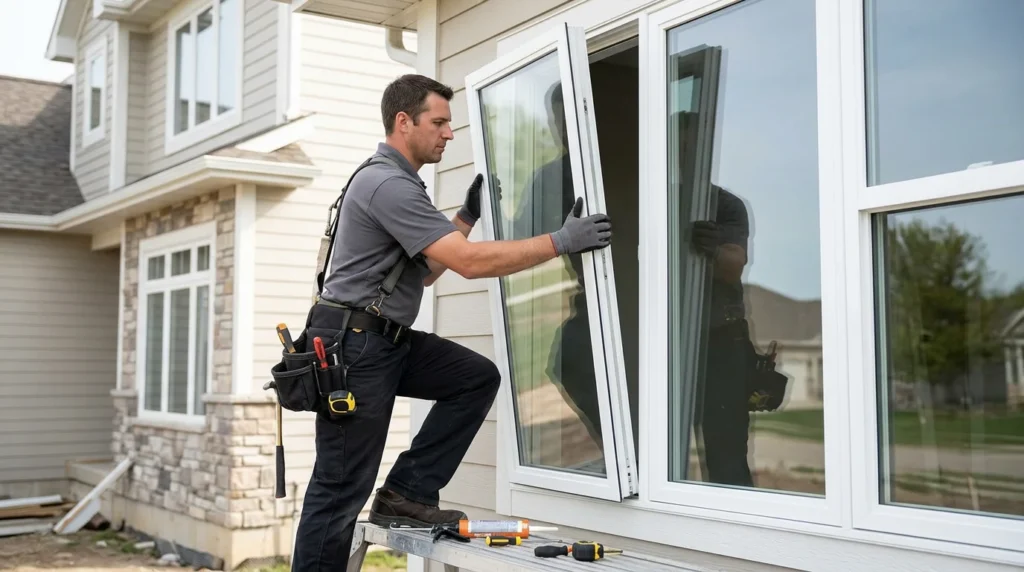
Quick answer: To get an accurate window installation quote, gather the window count and approximate sizes, pick a frame material and glass package, and decide whether you want insert (retrofit) or full-frame replacement. Request a written scope that lists what’s included—removal and disposal, flashing/water management, insulation/sealing, trim and finish work, and warranty terms. A site visit is typically needed to confirm measurements and spot rot or out-of-square openings.
What to Prepare Before You Request a Quote
Start with the basics: how many windows you’re replacing, which ones, and what problems you’re trying to solve (drafts, hard-to-open sashes, condensation between panes, outside noise). If you can find the manufacturer label on the existing window, snap a photo. If not, measure the visible glass and note any rooms where access is tricky; the installer will still verify on-site.
Be ready to choose between insert replacement (keeping the existing frame) and full-frame replacement (removing the old frame back to the rough opening). Inserts are often less disruptive, but they can slightly reduce glass area and won’t address damage in the existing frame. Full-frame work typically involves more labor and finish repair, but it’s the cleaner reset if the frame is compromised or you’re changing window style. When you request a window installation quote, mention which approach you’re leaning toward so the scope matches what you actually want.
Decide what “finished” means to you. One quote may include new interior casing and exterior coil wrap, while another may only install the window and leave trim repair/painting to you. Those are both legitimate scopes, but they’re not comparable unless the finish expectations are spelled out.
What a Good Quote Should Include
A solid quote spells out the window specs (brand/series, frame material, glass package, grid style if any, color, and opening type like double-hung or casement). It also separates product from labor so you can compare apples to apples. If the quote just says “replace windows” with one total number, ask for a clearer scope.
Look for line items covering removal of old windows, disposal, installation method (insert vs full-frame), insulation/sealing around the frame, and flashing/water management. Many contractors will include an assumption such as “no hidden rot” and then describe how change orders are handled if damaged wood is found.
Warranty details should be written down: manufacturer coverage on the window, and the installer’s workmanship warranty. Ask who you contact if a sash won’t lock properly or you feel air leakage—this varies by contractor and manufacturer process.
Common Add-Ons That Change the Price
Hidden damage is a frequent swing factor. Soft wood at the sill, staining under the window, or bubbling paint can signal rot that only becomes obvious once the unit is removed. Access can also change labor time: second-story windows, steep roofs, and tight landscaping often require extra safety setup.
Glass choices can move the quote. Double-pane is common; triple-pane, laminated glass (often chosen for noise and security), or upgraded coatings can add cost and weight. If street noise is your main complaint, ask about laminated glass plus air-sealing details rather than assuming “thicker glass” alone fixes it.
Permits and code-driven items vary by contractor and local code, especially if you’re changing the opening size, altering structure, or adding egress windows. Even when a permit isn’t required, proper flashing and water management should still be part of the installation plan.
Quote Request Template
Copy/paste this and send it to any installer so quotes come back comparable:
Subject: Request for written window replacement quote
Details to include in your quote:
• Window schedule: count, location/room, opening type (e.g., double-hung/casement), and verified sizes
• Window specs: frame material, glass package (low-E/coatings, gas fill, laminated if applicable), color, grids (if any)
• Install method: insert (retrofit) or full-frame; note any situations where you recommend switching methods
• Trim/finish scope: interior casing/stool/apron work; exterior wrap/trim; caulk/paint responsibilities
• Water management: flashing approach and air/water sealing details
• Rot/repair allowance and change-order policy: how hidden damage is handled and how pricing is approved
• Warranty terms: manufacturer warranty summary and workmanship warranty length/coverage
• Lead time and schedule: order time frame and estimated install duration
• Payment schedule: deposit amount, progress payments (if any), and final payment timing
How to Compare Quotes Without Regrets
Compare quotes by matching the same window type and installation method across bidders. If one contractor quotes inserts and another quotes full-frame, the lower number may simply reflect a different scope. Example: an insert install may reuse existing interior trim, while a full-frame install may require new casing and drywall touch-up—both affect labor and finish costs.
Confirm what’s included for trim, paint touch-up, and debris cleanup. Example: one quote might include exterior coil wrap on all windows, while another excludes it (or prices it as an add-on). Those differences can make totals look far apart even if the window product itself is similar.
Bring the template above to any installer, ask for the scope in writing, and make sure each quote clearly states assumptions (like “no hidden rot”) and how changes are approved before work proceeds.