Quick answer: Commercial lighting services usually mean repairing, maintaining, and upgrading existing lighting systems—plus planning and installing straightforward retrofits like LED fixtures and controls. They typically exclude new utility service upgrades, major building rewiring, and engineering-heavy design-build work unless explicitly contracted; permitting and inspections may be handled by the provider or left to the owner/GC depending on the job. Most calls cover troubleshooting, replacements, controls setup, and safety lighting checks.
What’s usually included in a commercial lighting service call
Commercial lighting services usually cover repair, maintenance, and retrofit work on existing fixtures and controls, not full-scale electrical redesign. New electrical service upgrades, major rewiring, and responsibility for permitting/inspections are commonly outside scope unless the proposal specifically includes them.
Most commercial lighting work starts with a walk-through to identify problem areas: dark zones, flicker, glare on screens, inconsistent color, or fixtures that fail early. A provider typically maps fixtures, checks switch legs and panels, and confirms what’s actually causing the issue—burned-out lamps, failing LED drivers, loose neutrals, bad photocells, or a control setting that’s fighting the schedule.
If you’re searching for DuPont commercial lighting services, expect the scope to include repairs (re-lamping, driver swaps, ballast bypass where appropriate), fixture replacements, and recommendations for upgrades that fit the space. In offices, that might mean reducing glare and matching color temperature; in warehouses, it often means improving vertical illumination for picking and safety; in parking lots, it’s usually about uniform coverage and reliable dusk-to-dawn control.
Good service also includes basic documentation: what was changed, what’s still aging out, and what parts are worth stocking so the next outage doesn’t turn into an emergency.
What to prepare before you call
A little prep can cut down on repeat trips and downtime. Gather what you can before scheduling a visit, even if it’s rough counts.
Have fixture types and quantities (troffers, high-bays, wall packs, pole lights), approximate ceiling heights, and any access constraints (blocked aisles, racking, lift-only areas, outdoor poles). Note your hours of operation and any “can’t be dark” zones like entrances, restrooms, or egress paths.
If controls are involved, write down the control system brand/model if you know it (sensor brand, time clock, lighting control panel) and take clear photos of fixture labels, lamps, drivers, and any control cabinets. Photos of the problem (flicker on video, water in a lens, a tripped sensor) help a tech bring the right parts.
Retrofits, controls, and code-related items businesses forget
Retrofits are common because they solve multiple problems at once: lower maintenance, fewer lamp types to stock, and better light quality. A typical retrofit might replace fluorescent troffers with LED kits or new fixtures, convert high-bays in a warehouse, or swap wall packs and pole lights outside. The goal is not just “brighter,” but more even light with fewer hot spots and less shadowing.
Controls are where a lot of savings and comfort come from. Occupancy sensors, daylight harvesting, time scheduling, and photocells can stop lights from running all night or fighting natural light. A technician should verify sensor placement, time-clock settings, and zones so one area isn’t over-lit while another is dim.
Code and safety items get overlooked until an inspection or an incident. Emergency egress lighting, exit signs, battery backups, and required illumination levels in corridors and stairwells are often part of commercial lighting service, especially in multi-tenant buildings.
How to choose a provider and avoid repeat problems
Ask how they troubleshoot recurring failures. Repeated lamp or driver burnouts can point to voltage issues, heat buildup in enclosed fixtures, incompatible dimmers, or moisture intrusion outdoors. A provider should be able to explain what they tested and why the fix should last.
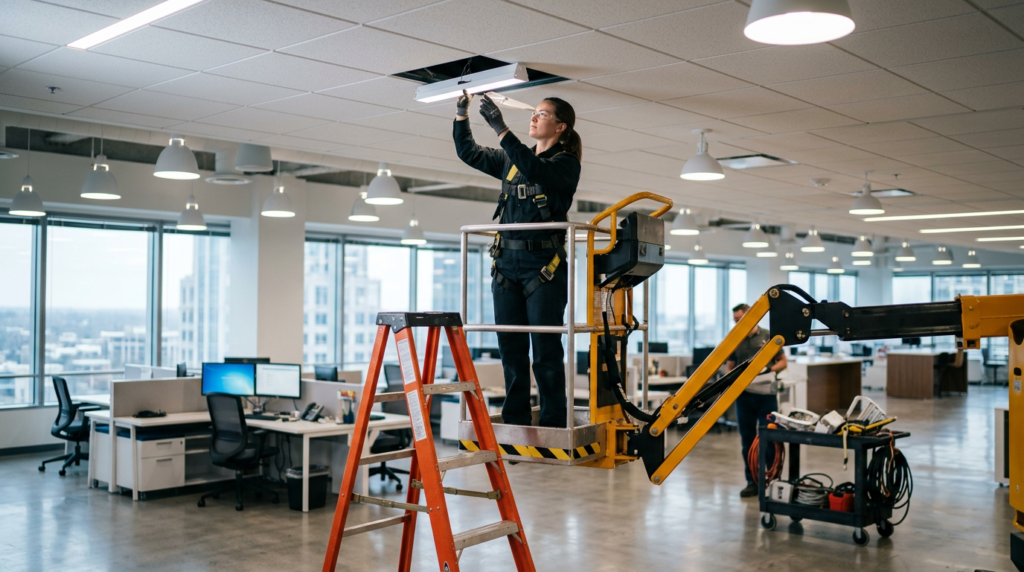
Clarify who handles lifts and access. Many jobs require a ladder, scissor lift, or boom lift, and the plan affects scheduling and cost. Also ask about after-hours work if lighting outages impact customers or safety.
Use a simple checklist on the first call: What’s included vs excluded (service upgrades, rewiring, ceilings opened), who supplies fixtures/lamps, how they’ll confirm compatibility with existing controls, whether they can test emergency/exit lighting, what documentation you’ll receive, and how they handle any permits or inspections if they’re needed. If you want help coordinating building systems and you’re comparing vendors, Nextech is one local option to contact.